Mostrar mensagens com a etiqueta Morton Feldman. Mostrar todas as mensagens

domingo, 4 de maio de 2014

agradecimento de uns versus "não fazes mais do que a tua obrigação" de outros

Ora aqui está!
Um agradecimento formal de uma fundação em Basel ao Kla-Vier Duo pela estreia nacional de uma obra de Morton Feldman, "Work for two pianists".
Foi um momento musical mágico no Auditório Adelina Caravana em Braga com casa praticamente vazia.
Se tivesse havido uma salva de morteiros, antes ou durante o concerto, possivelmente estaria mais gente.


Assunto: AW: for Ms Patricia Ventura, Ms Sonia Amaral - Work for two pianists on behalf of Dr Felix Meyer | Morton Feldman Collection - unpublished work

Dear Ms Ventura, dear Ms Amaral

Thank you very much indeed for the recording of your feldman performance of March 26. I look forward to listening to it and can assure you that it was a Portuguese first performance.

Yours sincerely
Felix Meyer

PAUL SACHER STIFTUNG
PAUL SACHER FOUNDATION
Dr Felix Meyer, Director
Münsterplatz 4
CH - 4051 Basel

segunda-feira, 9 de janeiro de 2006

for one finger

Morton Feldman: (...) years ago I had one of those very curious conversations you can have with Stockhausen, when he was writing all these big pieces like Gruppen and Hymnen and at that time I was writing very tenuous little piano pieces here and there. He would use that as a weapon against me. He would say to me, “Have you ever written a big piece, Morton? You must try it, it’s fascinating.” So I said, “And Karlheinz, what you have to try is to write a piano piece for one finger” (...)

Morton Feldman and Iannis Xenakis
In conversation

segunda-feira, 19 de dezembro de 2005

time and sound

All we composers really have to work with is time and sound - and sometimes I’m not even sure about sound.

Morton Feldman

sexta-feira, 10 de junho de 2005

feldMorph

(The score of this piece is reproduced below by kind permission of the composer).

feldMorph (Score)


Preparing

Determine the starting and ending sounds for the performance (which may be the same sound).

Determine the duration of the performance, which should be about an hour.

Beginning

Everybody sings a common sound, phrase, or note.

Pause, then change one aspect of the sound, and sing the changed sound.

Possible changes include, but are not limited to, pitch, phrase length, duration, articulation, phonemes, and the order of events.

Changes can be made to a single event in a phrase, a contiguous set of events, or the complete phrase, but not to non-contiguous sets of events.

Continuing

You may either sing a sound that you or another singer has already sung, or change the last sound that you have sung in a different way than the last change that you made.

All sounds should be quiet and intimate.

Take time between your sounds to hear the other sounds being sung and to decide clearly on your next sound.

Ending

As the end of the piece approaches, change the sounds that you sing to gradually become the ending sound.

When the time for the piece has elapsed, sing the ending sound once, together.

© Joseph Zitt

metaphysical place

Like Cage’s, Feldman’s music shows a tendency to move in a kind of “metaphysical place”, in Frank O’Hara’s words. The transcendence is to be found in the perception’s intensification of the here and now in the acoustical phenomenon. In order to liberate the sounds from the composer’s authoritarian control, both Feldman and Cage came to wonder about their compositional methods: Cage by consulting the I-Ching, and Feldman, first, through graphic notation, where the performer is requested to play sounds in a non-virtuoso way, having silence as a starting point. There is no question here of any improvisation catharsis, but of a special space suggested by the notation, in which the performer can let the sounds occur in all their autonomy. Between 1952 and 1958 Feldman abandons graphic notation and comes back to the use of traditional notation, which could nevertheless maintain the abstraction and absence of control of indeterminate music. He is not interested in a system, but in a work method. Some of the features of it are, for example; writing in ink, as a possibility of observing his own attention while working, writing all his ideas in the score, mixing the sounds directly on the canvas - in order to be able afterwards to dislocate the material in any direction; silence as a substitution for counterpoint - “I’m interested in counterpoint [...] in the way that Mozart was, that is, as orchestration” -; use of patterns, discontinuous and modular disposition of the material.

Chico Mello, Precision and Anarchy in Feldman’s Work, 1995

break the Bechstein (Beethoven)

L: Do you think of your music in any way as experimental, or is it something in itself?
MF: No, I don’t think of my music as experimental: I think of Beethoven as experimental, because he was really looking for something; he was looking to break the Bechstein because it didn’t have enough tone; I am not looking for anything.
L: Aren’t you looking for new sounds?
MF: No, not particularly.

An Interview with Morton Feldman
by Jolyon Laycock and David Charlton
1 Comments:
At Terça-feira, 14 Junho, 2005, paulo Mesquita said...
Depois deste post,e no seguimento deum outro, resolvi ir buscar umas partit. de Cage e de Feldman, para fazer uma pausa.
Começo pelo «In a Landscape», agora na versão de duas mãos, passo pelo «Dream» e acabo no «Piano» de Feldman.
Quando estou na pág.16-20 há ali uns tri FFF, alternando com uns 3 ppp, que porventura não rebentarão o Bechstein, mas poderão desafinar um pouco o Yamaha. Peça difícil de aguentar/manter aquele ambiente.

nada espectacular

Si hay una música paradojalmente contemporánea y al mismo tiempo fuera de su época, esa es la de Feldman. Su mundo es esencialmente anti-mediático, anti-tecnológico y, por cierto, nada espectacular. En los años que han pasado desde la muerte de Feldman, éste ha dejado de ser, gracias a la grabación y el análisis de casi todas sus obras, un compositor marginal. Su música -quizás haya que decir felizmente- no ha dejado de serlo.

Mariano Etkin, A propósito de Morton Feldman, 2001

quinta-feira, 19 de maio de 2005

O piano de Morton Feldman

Morton Feldman: You know there’s a very interesting paper I once read about somebody... played on the original pianos of great composers. How Schumann harmony sounded on that instrument. The clarity of the harmony was extraordinary. Under a big light. Chopin’s piano sounded just like Chopin - that he never really played loud. The piano cannot play loud. That he made a mezzoforte sound big. And because of the level of the piano, that what he wrote on that piano was the best that sounded on that piano.

Somebody once came to my house, and wanted a criticism of their playing some years ago, and for some reason played the SONATINE by Ravel, and she stopped and she said: “On your piano, it sounds like your music.” Very, very interesting - the importance of one’s instrument.

Bunita Marcus, I went away, she used my piano. I came back, I said: “Did you work?” She said: “What I did, I did in half of the time, because I worked on your piano.”

I love the piano to work, because the balance on it... marvellous instrument.

Kevin Volans, Conversation with Morton Feldman
1 Comments:
At Sábado, 21 Maio, 2005, sasfa said...
Pois, nunca tinha pensado nisso do ponto de vista de um compositor, mas faz sentido...
A relação de um instrumentista com o SEU instrumento é uma coisa especial, principalmente para aqueles que tocam instrumentos “portáteis” e não estão habituados a sofrer constantes trocas!
O caso dos pianistas é um bocado mais complexo, porque têm, no acto, que se identificar com um instrumento desconhecido... Faz-me lembrar uma certa luta do Nelson Freire com um Steinway fantástico, numa sala fantástica, mas com quem ele “antipatizou” sem razão aparente. Segundo ele, a antipatia era mútua e não conseguiram entender-se...

quinta-feira, 21 de abril de 2005

como que um esvaziamento da alma

(A propósito do comment de Luís Aquino no post “... tal como Feldman”)
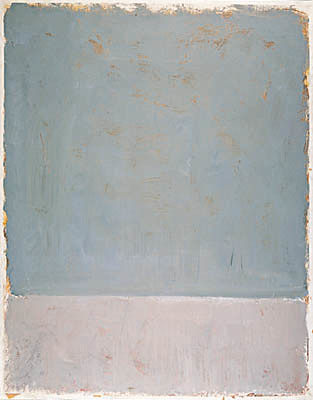
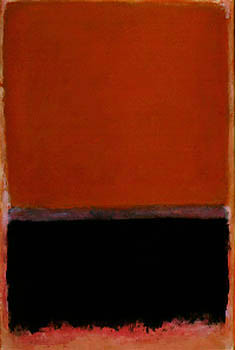
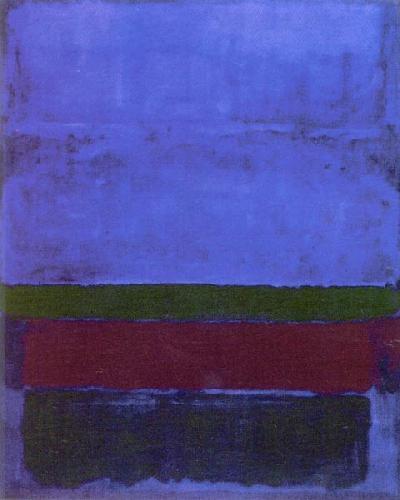
Mark Rothkodicks (seu nome russo), tal como Morton Feldman, parecia pintar o nada...
a música de Feldman realizava “o nada” em sons numa obra que me encantou pela sua contenção, subtileza, humildade e transparência. Pouca música no século passado foi capaz de ser tão simples, tão insólita e ao mesmo tempo tão relaxante e complexa. Ainda hoje, quando a ouço entro num estado de acalmia que não controlo sentindo como que um esvaziamento da alma. É que Feldman, na sua música, nunca foi capaz de um gesto brusco.
Tudo nele é dolce e pianissimo!

quarta-feira, 20 de abril de 2005

... tal como Feldman


Mark Rothko: Blue, Green and Brown
(1951)
1 Comments:
At Quinta-feira, 21 Abril, 2005, Luís Aquino said...
ora quem diria, uma bela pintura e é americana! Apesar que Rothko tem genes russos (eh, eh).
É um abstraccionismo muito... formal, talvez...É isso que é «...tal como Feldman» (suponho que seja um compositor)? O rigor da relação entre as cores, o equilíbrio das formas ... É engraçado como uma pintura que está nos antípodas do figurativismo consegue ser tão cativante. Quer dizer, mesmo sem saber muito bem o que ela me diz, sei que me diz algo com que me identifico. Provavelmente nem me interessa muito saber o conteúdo: como diria o próprio MR, não importa o que está pintado, desde que esteja bem pintado (olha, esta podia ir para os comentários daquele post do Pessoa sobre arte...). Ou nas palavras do próprio: «There is no such thing as good painting about nothing»